SEO in 2026 What Changed and What to Do Next
SEO in 2026 gives website owners more ways to see how their content appears in AI search, while some familiar search features have disappeared. People can ask follow-up questions, search with images and use assistants to compare options. These changes affect how you explain an offer and measure its usefulness.
The practical response is to keep your information accurate, make important pages easy to use and separate exposure from visits and business results. You do not need to publish a page for every prompt, add special AI markup or start a protocol project to keep up.
This is a review of developments and practical lessons through 14 October 2026, not a prediction about the rest of the year. It brings together our detailed guides so you can choose the next task that fits your website.
The changes that matter at a glance
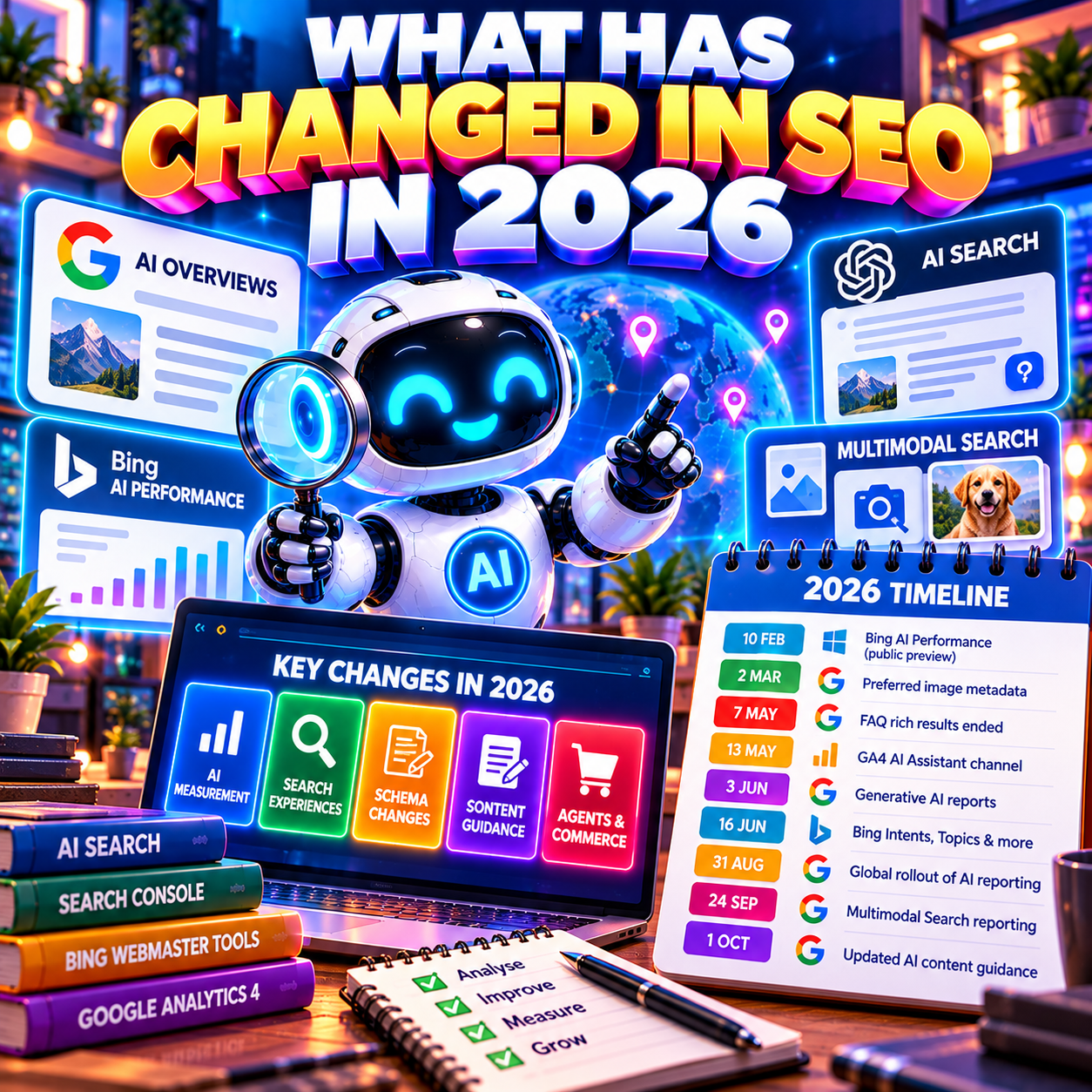
| Area | What changed or became clearer | What to do |
| AI measurement | More first-party visibility and referral reporting became available. | Use each report for its own question; confirm enquiries and sales separately. |
| Search experiences | Conversational and image-based journeys broaden the ways people investigate an offer. | Answer real customer decisions and inspect the relevant destination pages. |
| Schema and files | FAQ rich results ended; Google clarified common AI optimisation misconceptions. | Review supported features and remove citation or permission promises. |
| Content and business facts | Current guidance reinforces original value and human review. | Correct misleading information before producing more pages. |
| Agents and commerce | New interaction and buying options are developing with specific support requirements. | Improve ordinary interfaces first; investigate integrations when relevant. |
Some items are new features. Others are clarifications or corrections to advice that was already too broad. A documentation update is not automatically a new ranking signal or evidence that every website must change.
A short timeline of verified 2026 developments
| Date | Development |
| 10 February | Microsoft introduced AI Performance in Bing Webmaster Tools as a public preview. |
| 2 March | Google clarified preferred-image metadata guidance. |
| 7 May | Google stopped showing the FAQ rich result feature; the documentation notice followed on 8 May. |
| 13 May | GA4 introduced its AI Assistant channel for recognised assistant referrals. |
| 15 May | Google added its broader guide to optimising for generative AI Search features. |
| 3 June | Google announced dedicated Generative AI performance reports. |
| 16 June | Bing added Intents, Topics, Citation Share and Compare in preview. |
| 31 August | Google confirmed worldwide rollout of its Generative AI reporting. |
| 24 September | Google began the global rollout of web multimodal Search reporting. |
| 1 October | Google updated its guidance on using generative AI content. |
These dates concern the specified announcements or documented changes. Availability, usable data and eligibility still depend on the feature and property. The sections below explain the practical limits.
Google documentation changelog
Google Analytics product updates
Bing’s June reporting additions
Google Generative AI reporting launch and rollout
Google multimodal reporting announcement
AI visibility is easier to inspect but still needs interpretation
The biggest reporting improvement is that owners have more direct evidence. You no longer need to treat a traffic drop or an occasional assistant screenshot as the only way to investigate AI search visibility.
Google reports AI appearances separately
Search Console’s Generative AI reports provide dedicated views of impressions in supported AI features, including AI Overviews and AI Mode. The Search AI visibility is already included in overall Search reporting. Do not add it to the total as another audience.
Use available page, country and device information to choose a useful investigation. The report describes appearances of your URLs, not every unlinked brand mention. It does not provide a complete path from a particular answer to a customer’s sale. A property may have little data or no available report.
Google’s Generative AI report announcement
Bing reports supported AI citations
Bing AI Performance counts displayed citations across Microsoft Copilot, AI-generated Bing summaries and selected partner experiences. That coverage is not every AI assistant. Its page and grounding-query views help you inspect which information is being referenced.
The June preview additions provide more context. Topics and Intents group retrieval context, Compare helps inspect changes and Citation Share relates to a specific grounding query. Citation Share is not traffic share, a content-quality score or a universal ranking, and it does not disclose competitor domains.
Microsoft’s expanded AI visibility insights
GA4 reports recognised assistant visits
GA4’s AI Assistant channel groups visits from recognised assistant referrers. Google AI Overviews and AI Mode are excluded from that channel; their unpaid Search visits belong in Organic Search. The standalone Gemini assistant and Google’s AI search features are different experiences.
For visits, use consistent session-based reporting and check landing pages. Missing referrers, consent and implementation gaps mean the channel cannot reveal everyone influenced by AI. Do not relabel Direct traffic as AI traffic because an attribution explanation is missing.
GA4 default channel definitions
Keep three stages separate: exposure, visits and outcomes. An impression is not a unique person, a citation is not a visit and a form event is not automatically a qualified enquiry. Use booking, sales or CRM records to check quality and value.
How to Measure SEO Success When Search Uses AI
How to Track AI Search Visibility with Free Tools
AI Mode and AI Overviews need different explanations
AI Overviews are generated summaries within Google Search. AI Mode is a conversational Search experience where someone can explore a question through follow-ups and source links, including on desktop. It should not be described as an Android-only assistant.
The practical difference is the journey. A customer might begin with a broad question, add a location, compare alternatives and then ask about suitability. Your page needs enough context to help with the decision when they reach it.
Google’s May I/O announcement described further conversational, information-agent and booking developments. Announced rollout plans are dated context, not proof that every capability is available to every customer or business. Keep platform and market details in the specialist guides.
Google’s Search announcements at I/O 2026
For example, a person seeking a gardener may compare one-off clearance with regular maintenance, add their postcode and ask whether waste removal is included. A clear service page should explain the actual area, service scope and quotation route. It cannot guarantee that Google will recommend the business.
Google AI Mode Explained for Small Business Owners
Google AI Overviews A Practical Guide for Businesses
Some familiar SEO promises no longer belong in your checklist
FAQ markup no longer produces Google FAQ rich results
Google retired the FAQ rich result feature from 7 May 2026. A guide promising expandable FAQ search results now needs correction. Keep useful questions and answers visible on the page, but do not make that feature the reason for including them.
Schema vocabulary and Google-supported search features are separate. Use appropriate markup that matches the page, verify current support and test with the right tool. Google’s Rich Results Test checks supported Google features; the Schema Markup Validator covers vocabulary more broadly.
Neither FAQ nor HowTo markup guarantees AI citations. Valid structured data does not promise rankings or display. Review old examples and audit links rather than adding markup automatically.
Schema Markup Explained What Still Helps Your Website
llms.txt is an optional information proposal
An llms.txt file can provide a curated guide to useful resources for systems that use it. It is not a training-permission mechanism or guaranteed attribution system. It does not replace robots.txt, provider controls or accurate public pages.
Google’s 2026 guidance clarifies that it does not use llms.txt as a special Search visibility mechanism. There is no requirement to create it for Google’s AI features. Maintain one if a specific use case merits the effort, not because it is sold as a compulsory ranking fix.
llms.txt Explained What It Does and What It Does Not
GEO is not a new universal ranking system
Generative engine optimisation, or GEO, is a label for work concerned with AI search visibility. Google treats optimisation for its generative AI Search features as part of SEO. Its guidance rejects compulsory chunking, special AI files and special schema as requirements.
Google’s generative AI Search optimisation guidance
Use clear sections, examples and direct explanations because they help readers. You do not need an artificial word count or a separate page for every phrasing. Ask what a proposed tactic improves and how its result will be checked.
Generative Engine Optimisation A Practical Guide to AI Search
Search access and training controls must be considered separately
This distinction is important, but it is not an invention of 2026. A security setting that blocks a useful search crawler can affect access, while a provider’s training opt-out may serve a different purpose.
OpenAI documents OAI-SearchBot for ChatGPT search and GPTBot for potential model-training use. Those settings are independent: a website can allow the search crawler while disallowing GPTBot. Do not assume every training restriction blocks Google or every AI search system.
Check robots.txt, public page access, security challenges and blocked requests. With Cloudflare or another security service, review the actual rule and affected crawler rather than relying on a broad label. Record authorised changes, keep a rollback route and retest key pages.
Is Your Website Blocking Google or AI Search
Human editorial review matters more than publishing volume
Google’s October guidance reinforces review for accuracy and trustworthiness, including titles, descriptions, structured data and image alternative text. This is not a blanket ban on AI-assisted writing or a requirement to prove that every sentence was typed manually.
Google’s guidance on using generative AI content
Use AI to organise research, compare drafts or identify claims for checking. Supply useful original business input and verify every proposed fact, example, source and author claim. Publishing large quantities with little added value can breach scaled-content policies.
A service business could explain a real preparation process, the jobs it declines or a common decision customers struggle with. That experience is more useful than a polished rewrite of generic advice. If an example is fictional, label it.
How to Use AI to Write Helpful SEO Content
Plan around meaningful customer decisions: choosing, comparing, buying and using. Query fan-out describes related searches a system generates; customer follow-ups are another part of the journey. Neither justifies creating dozens of overlapping prompt pages.
Content Planning for Customer Questions and AI Search
For a hobby site or an established archive, refreshing a useful page may be the manageable next task. Keep what works, update misleading advice, combine genuine overlaps and archive historical material honestly. Record the substantive changes. A new date alone is not an improvement.
How to Refresh Old Content Without Creating More Work
Accurate commercial information helps across search experiences
Local businesses still need correct hours, services, areas, locations and contact routes. Genuine reviews and useful local pages support customer decisions. Do not invent an office, stuff keywords into a business name or manufacture feedback to chase AI recommendations.
Local SEO and AI Search Help Customers Find Your Business
Retailers should check prices, stock, variants, images, delivery and returns across visible pages, feeds and supported product markup. A selected colour should have the correct photograph. AI checkout is a separate capability with platform, merchant and market conditions; not every SME needs UCP.
Ecommerce SEO Product Information That Helps Customers Buy
External evidence also needs judgement. Earn relevant coverage through expertise, useful research, local partnerships or genuine customer stories. A backlink, an unlinked mention and an AI citation are different things. Paid coverage should not masquerade as an earned endorsement.
Digital PR for Small Businesses in the Age of AI Search
Check what an AI answer says as well as whether it cites you
An answer can cite your website and describe the wrong service or location. A brand-facts audit therefore serves a different purpose from citation tracking. Begin with an approved record of what the business actually offers.
Check a small set of real customer questions more than once. Save the exact question, answer, visible sources and conditions: platform, language, location, session and date. Compare factual claims with evidence and log the issue, owner and correction.
Treat each answer as a sample. Being absent is not automatically an accuracy error; a recommendation can be unsuitable even when the name is correct. Correct relevant owned pages and listings, then retest without promising a fixed correction time.
How to Check What AI Search Says About Your Business
Apply the same discipline internationally. An English-speaking customer in Warsaw may need the same Polish service area and złoty price as a Polish-speaking customer. Translate the words and review local terminology, availability, examples, sources and the enquiry or purchase journey.
Language, location, platform and session can change observed answers. Research from sampled markets cannot establish a universal Polish or global citation rule. Keep hreflang as a search implementation topic without assuming every chatbot uses it.
International SEO and AI Search Localise Beyond Translation
Images now have a clearer reporting story
Google clarified preferred-image metadata in March. Relevant schema.org image information and og:image can influence preview selection, but the result remains automated. A preferred image is not a promise of a specific Search or Discover thumbnail.
Use helpful visual context, appropriate text alternatives and accurate product photographs. Check the featured image, social-image preference and relevant markup for outdated or inconsistent references. Keep essential instructions and specifications available in text.
September’s web multimodal reporting covers image-input searches such as Lens, Circle to Search, uploads and Chrome image search. Web: multimodal is different from the Image search type for Google Images results. A page containing photographs does not automatically generate multimodal traffic.
Google’s multimodal reporting announcement
Use the filter where relevant data exists; do not assume every property has observations. Missing data alone does not establish that the images are wrong. Keep detailed reporting screens in the practical guide and inspect the destination page before deciding on an edit.
SEO Audit Checklist Including Images and Visual Search
Agents are worth understanding before buying an integration
An AI agent can take steps towards a goal using its tools and permissions. It might compare products, check options or help prepare a booking. That is a task-usability question, separate from being mentioned in an AI answer.
Start with labels, real buttons, working forms, visible information and stable layouts. A booking-request form should confirm that a request was sent, not imply that an appointment is reserved. Test the underlying system as well as the on-screen message.
WebMCP and UCP are evolving options for relevant website tasks and commerce setups. Check current client support, eligibility and maintenance with a specialist before investing. Clear ordinary interfaces are a useful first step for most owners.
AI Agents Explained Can They Use Your Website
A Google update still requires a proper diagnosis
A drop happening near an update does not establish its cause. Compare affected pages, queries, devices and countries. Check tracking, seasonality, security and indexing before deciding what to rewrite.
Core, spam and Discover updates concern different systems or surfaces. Use Google’s dated update history for context and the relevant report for the affected traffic. Avoid fast-recovery promises and broad changes based on a few days of uncertain data.
Google’s ranking update history
Hit by a Google Update How to Investigate a Traffic Drop
What to do next on your own website
Choose one important customer journey and one useful page. For a fictional garden-maintenance business, that could be deciding whether the service covers a postcode and requesting an appropriate quote. The owner should improve that route before creating more AI-focused articles.
- Correct misleading services, locations, prices or advice on the page and relevant listings.
- Test access, images, navigation and the actual enquiry or purchase outcome.
- Review relevant markup and remove obsolete feature promises.
- Collect available visibility, visit and outcome data with consistent definitions.
- Sample a few important AI answers for accuracy, then record one practical correction and retest.
Keep a short change log with the task, evidence, owner and review date. Review results over comparable periods without assuming that every difference was caused by your edit. If the evidence is sparse, keep the limitation visible.
The useful response to 2026 is a maintained website and a clearer understanding of its results. Better reports and new experiences give you more questions to investigate; they do not require you to abandon working SEO foundations.
Frequently asked questions
Do I need a separate AI SEO strategy
You need clear goals and a way to inspect relevant AI experiences. Many first actions overlap with ordinary SEO, content maintenance and customer-journey work. A separate programme is only useful if it has a defined purpose and capacity to maintain it.
Can I add AI impressions to my overall Google total
No. The Google generative AI visibility discussed here is already included in overall Search reporting. Keep the subset labelled and retain the same filters when comparing periods.
Should I remove useful FAQs
No. Google retiring a rich result does not remove the value of visible answers. Keep them if they help readers, while correcting the promised search feature and reviewing applicable markup.