AI Search Brand Audit How to Check Your Business Facts
An AI answer can mention your business and still send a customer in the wrong direction. It might describe a service you do not offer, confuse your location with another company or recommend you for a job you cannot take on.
A business facts audit checks whether those answers are correct and helpful. Start with an approved record of what your business actually does, ask a small set of customer questions, save the answers and correct the information you can control. You can do this manually without buying a monitoring platform.
The result is a list of issues and practical corrections. It is a sample of answers under recorded conditions, not a precise measure of how every customer sees your business.
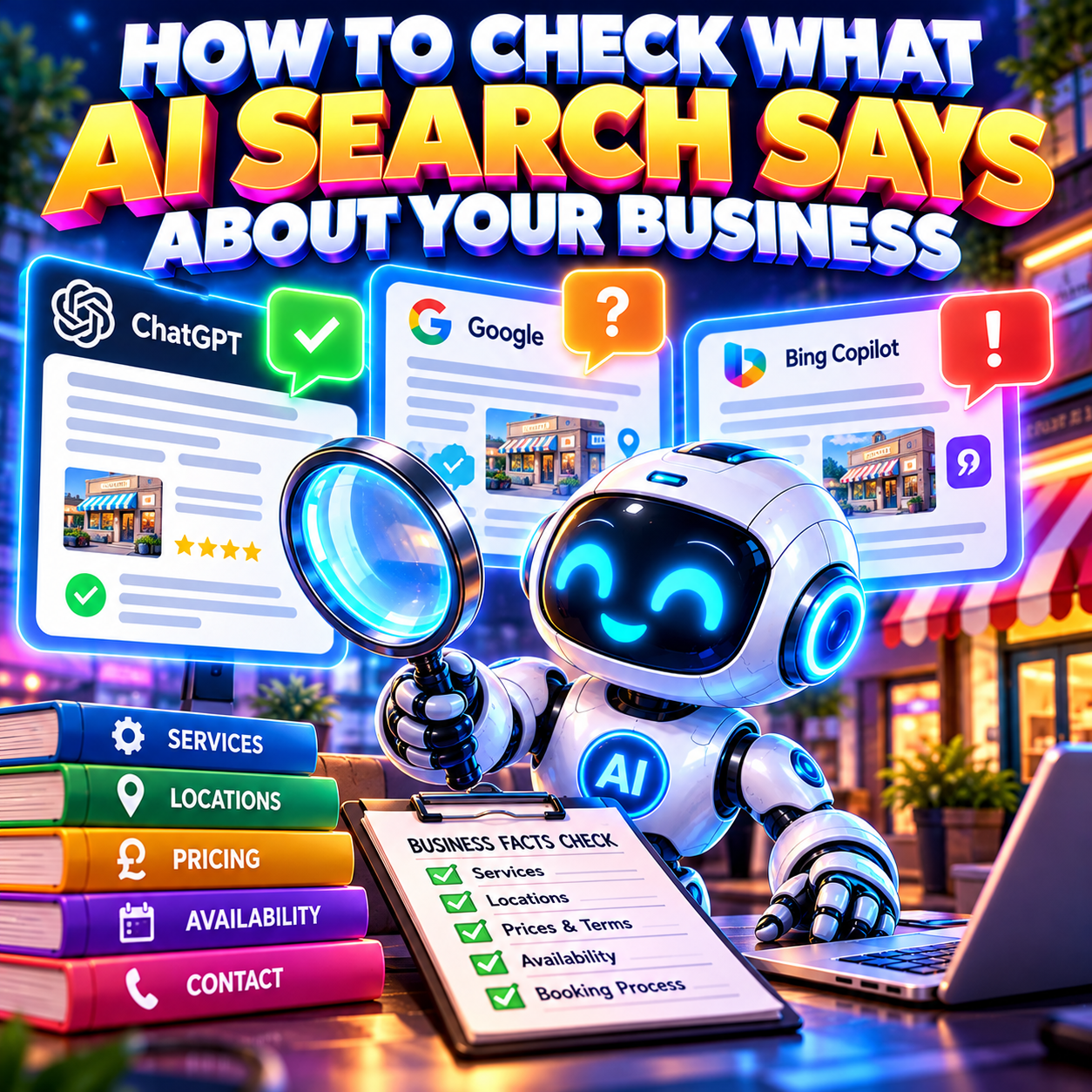
Decide what you are checking
Citation tracking asks whether an AI system references a page. This audit asks what a customer would understand about your business after reading the answer. A citation to your website does not establish that the answer is accurate, and an answer without a visible citation still needs checking.
| Observation | Question to ask |
| Business mentioned | Does the answer identify the right business? |
| Website cited or linked | Which page is referenced, and does it support the claim? |
| Business recommended | Is it suitable for the customer’s stated needs? |
| Business described | Are services, locations, terms and limitations correct? |
| Business absent | Was a recommendation expected? Absence alone is not a factual error. |
Choose the customer decisions that matter most. For a local business, that may be whether you cover their area, offer the required service and accept bookings. For a shop, it may be whether a product is suitable, available and returnable under the stated conditions.
Do not begin by searching for praise. A confident recommendation for an unsuitable job can create more confusion than no recommendation at all.
Create an approved business fact sheet
Before judging an answer, establish what is true. Keep a short internal document that the owner or relevant team member has checked. Include a version date, an approver and a source for important facts. This is your working reference, not a special file that AI platforms are required to read.
Use public business facts. Keep customer records, confidential prices and private staff information out of prompts and shared screenshots. If a fact is uncertain, resolve it with the person responsible rather than letting an AI answer settle it.
| Field | What to record |
| Identity | Trading name, website, public contact details and enough context to distinguish similarly named businesses. |
| Services or products | Current offerings, important exclusions and who they are suitable for. |
| Locations | Customer-facing locations, service area and any limits. Separate an office address from an area you serve. |
| Availability | Normal hours, seasonal exceptions and how customers confirm current availability. |
| Prices and terms | Public prices or quote process, relevant conditions and where the current terms are published. |
| Customer route | Correct contact, booking or purchase page and what happens next. |
| Evidence and ownership | Source URL or internal confirmation, responsible person, approval date and next review trigger. |
Avoid turning opinions into approved facts. “We provide domestic window cleaning in these areas” can be checked. “We are the best window cleaner in the city” is a promotional judgement. Likewise, a certificate or membership should only appear if it is current and verifiable.
Make the website reflect the approved facts where they help customers. The internal sheet is useful for checking consistency; it does not replace clear service pages, current opening hours and accessible contact information.
Choose a small set of genuine customer questions
Use enquiries, sales conversations and questions your team regularly answers. Select a handful that could reveal a consequential misunderstanding. Five questions is a workable first exercise for a simple business, not a completeness target or a statistical benchmark.
Include questions that name the business, plus one or two that describe a customer need without naming it. Branded questions test the description directly. Discovery questions let you inspect suitability if the business appears.
Aleyda Solis’s prompt-library framework emphasises relevant business scenarios and repeated testing rather than an exhaustive list. Answers can vary by platform, time, location and session, so one response should not be treated as a fixed ranking.
S21 Aleyda Solis on building a representative prompt library
The following fictional example uses a window-cleaning company called Willow Window Care. Replace its name, locations and requirements with your own public facts. Avoid entering a real customer’s personal details.
| Customer question | What it checks |
| What services does Willow Window Care offer in York? | Correct services and business identity. |
| Does Willow Window Care clean gutters? | A service the business might not offer. |
| Can Willow Window Care visit a house in Leeds? | The boundary of its service area. |
| How do I book Willow Window Care and get a price? | Accurate contact route and quote process. |
| Who offers regular domestic window cleaning in York? | Suitability if the business is mentioned or recommended. |
Use ordinary wording and real constraints. Do not ask “Why is our business the best?” and then treat the prompted praise as independent evidence. Do not feed the approved fact sheet into the same conversation before testing: that checks whether the tool can repeat your input, rather than what it would otherwise say.
Keep the original wording in your log. A follow-up such as “What about a second-floor flat?” can be useful, but save it as a separate step with the preceding conversation. It is not directly comparable with the same question asked in a fresh chat.
Record the conditions before you run the questions
Pick one or two experiences relevant to your customers. Record the precise experience, such as Google AI Mode or a named assistant using its search function. Do not combine ordinary search results, AI Overviews and an assistant conversation into one undifferentiated result.
For this small audit, a practical starting routine is to run each question on three separate occasions within a week, using the same chosen conditions. This is an editorial suggestion for finding recurring problems, not enough to estimate population-wide error rates. If time is limited, test fewer questions carefully.
| Record for each run | Why it matters |
| Date and time including timezone | Identifies when the observation happened. |
| Platform and experience | Keeps different products separate; add the model or version if displayed. |
| Search or browsing state | Distinguishes a web-supported answer from an answer produced without that function. |
| Account and session | Note signed-in state, new chat or follow-up, and relevant history or memory settings. |
| Language and location | Record the language, stated customer location and any displayed location setting. |
| Question and answer | Save exact wording, the answer and visible source links. Record when no AI answer appears. |
Use a fresh conversation where possible. If the product requires an account, record that condition and avoid a thread that already contains information about your business. Private browsing alone does not prove that every influence, including location, has been removed.
You cannot control every part of a platform. Record what you can see, mark unavailable information as unknown and avoid claiming that the test recreates every customer’s experience. Keep any separately tested personalised session in a separate group.
Read the answer against the approved facts
Check the main answer and any recommendation details, not just whether your name appears. Compare each important claim with the fact sheet and current evidence. Where the tool offers sources, open the relevant pages and see what they actually say.
Use simple issue labels: incorrect, outdated, unsupported, unclear or no issue found. Reserve “incorrect” for a claim you can contradict with reliable evidence. A missing price may be an appropriate uncertainty if you only provide individual quotes.
A recommendation needs context. A business offering domestic cleaning may be suitable for a house but unsuitable for a high-rise commercial building. The problem is the mismatch with the stated task, not that the answer used a different adjective from your marketing copy.
Record “business not mentioned” separately. Do not mark that as an accuracy failure. Also separate a refusal or absent AI response from a completed answer; neither should quietly become a positive result.
Keep an issue log that leads to action
Give each observation an ID. Save the original answer or a screenshot privately, with its visible sources and test conditions. Where a source contains the same error, record that connection. A cited page is a lead to investigate, not proof that it caused the whole answer.
For each issue, record the question, observed claim, approved fact, evidence, customer impact, proposed action, owner and status. Link repeated observations to one issue so you do not create a new task for every repeat.
This compact sample continues the fictional Willow Window Care exercise. No real business has been tested for this article.
| Observed issue | Approved fact | Action and status |
| Gutter cleaning offered in two sampled answers. | Domestic window cleaning only; no gutter cleaning. | Check service page and cited directory. Correction assigned to owner. |
| Leeds bookings suggested in one answer. | Service area is York and named nearby villages. | Clarify area page; review old directory entry. Open. |
| An old phone number appears once. | Current public number confirmed by owner. | Update the stale listing and check website footer. Awaiting listing review. |
Deal first with errors that could send someone to the wrong place, waste their time or misrepresent eligibility for a service. Then address repeated commercial misunderstandings. A harmless wording difference can wait, and an unresolved opinion should not be logged as a factual correction.
Correct owned pages and relevant external listings
Start with the information you control
Compare your homepage, service pages, contact page, booking route, footer and relevant FAQs. Look for conflicting statements or obsolete pages that still describe discontinued services. Check the public view rather than relying only on the editing screen.
Make the correction where a customer would expect to find it. State the actual service area on the relevant page and explain a meaningful exclusion where necessary. Avoid adding a long list of services you do not offer simply to chase every mistaken response.
Check metadata and existing structured data for the same error. Update them to match the visible information. Publish a useful correction under the appropriate existing URL rather than creating a separate page for every prompt variation.
Google’s AI Search guidance continues to emphasise useful content and sound SEO. It warns against creating pages for every query variation to manipulate responses. Clear information can help readers and discovery, but it does not guarantee an AI citation or recommendation.
Google’s guidance for generative AI features in Search
Review external information selectively
Inspect your claimed business profiles, relevant directories, marketplace listings and partner pages. Start with those customers use and those connected to an observed error. Update a listing you control; request a factual correction from the publisher where you do not.
Keep the request specific: identify the page, the incorrect detail, the correct fact and a public source that supports it. Keep a record of the request and its status. A historical news report may remain accurate in its original context; ask for a contextual update where appropriate rather than demanding that history be rewritten.
Aleyda Solis’s third-party framework weighs relevance, business value, durability and effort. For this audit, the practical application is to prioritise sources that help real customers rather than pursuing every possible mention. Independent publishers retain their editorial judgement.
S19 Aleyda Solis on prioritising third-party citation opportunities
Do not manufacture reviews, impersonate customers or present paid coverage as an independent endorsement. If an answer summarises genuine criticism, distinguish a factual error from an opinion. You can correct the underlying facts or improve the service without trying to erase legitimate feedback.
Related guide to digital PR for small businesses
Retest and keep the outcome honest
After publishing, verify that your corrected pages work and the public listing shows any accepted change. Record these as separate milestones. A submitted directory edit is not the same as an approved public correction.
Repeat the original questions under comparable recorded conditions. Choose a sensible later check rather than assuming every AI platform will use the change immediately. There is no guaranteed correction timetable. If the experience or settings changed, note that limitation beside the comparison.
Use statuses such as source corrected, awaiting external update, not observed in later samples and still observed. Avoid declaring an issue permanently resolved because one later answer looks right. Retain the original evidence and dates so you can recognise a recurrence.
If the error persists despite accurate sources, keep the issue open and consider the platform’s available feedback route. Describe the observed error and link to evidence where appropriate. Feedback does not guarantee removal or a correction.
Report findings without inventing an AI ranking score
A useful summary states the scope, what went wrong and what you did. Keep platforms separate and distinguish sampled descriptions from visits, enquiries and sales.
For example: “We asked five fixed questions on three occasions in one named search-enabled assistant. Of 15 completed answers, three contained a service or location error. The gutter-cleaning claim appeared twice and an out-of-area recommendation once. We corrected the service page and requested a directory update. These results describe our recorded samples; they do not estimate all customer experiences.”
That report is fictional. Three errors in 15 answers is a count from a small, deliberately selected sample, not a universal 20% error rate. Repeated answers may share sources and are not necessarily independent observations. Avoid false precision from averaging different questions or products into one score.
You can report that an issue appeared in two of three runs of a specific question. State the question, platform and dates beside the count. Do not call it an AI ranking, market share or the percentage of customers receiving the wrong answer.
Measure exposure visits and business results separately
Make the next check manageable
Keep a small core set of important questions and review it when services, locations, hours or terms change. Add a question if customers report a new misunderstanding. Retire questions that no longer describe a real decision and keep a note of the change.
You might schedule a short periodic check if the business information changes regularly. Otherwise, use concrete triggers such as a move, a discontinued service, a new booking system or a reported error. The useful outcome is maintained information and fewer misleading answers, not a growing spreadsheet nobody has time to review.
- Approve current public business facts with the responsible person.
- Choose a small set of real customer questions.
- Record platform, session, location, language and timing.
- Repeat the questions and preserve the answers and source links.
- Log factual errors separately from absence and opinion.
- Correct useful owned information and relevant external listings.
- Verify publication, retest and report the sample limits.
Frequently asked questions
Do I need a paid AI monitoring tool
No. Manual checks and a simple document are enough for a focused first audit. A tool can help with collection at greater scale, but its settings, coverage and definitions still need review.
Does a link to my website mean the answer is correct
No. Read the claim and check the linked page. The answer may misread the source, mix businesses or add a statement that the cited material does not support.
Should I create a page for every question I test
No. Improve the existing page that answers the customer’s need. Create a new page only when there is a distinct useful topic, not simply another wording of the same prompt.
Can I guarantee that AI will use my approved facts
No. The fact sheet is your checking reference. Publishing accurate information and correcting relevant listings are useful actions, but you do not control every source or generated answer.