
SEO News Nov 2025 – Jan 2026 | Core Updates, AI & Search
Algorithms, AI, publishers, and the quiet reshaping of search

This timeframe exposed how search is evolving beneath the surface: fewer public announcements, deeper algorithmic refinement, accelerating AI integration, growing pressure on publishers, and the clear convergence of search, commerce, and artificial intelligence.
November 2025: Volatility without confirmation
Throughout November 2025, SEO professionals reported noticeable ranking volatility across multiple verticals, particularly informational content, news publishers, and affiliate-led websites. Despite this movement, Google did not confirm a Core Update, Spam Update, or Helpful Content Update during the month.
This reinforces a broader trend that has been building since 2024: Google is increasingly relying on continuous algorithmic refinement rather than frequent, named updates. Changes still occur, but they are less likely to be packaged into formal announcements.
Structured data deprecation begins in January 2026
One of the clearest technical announcements during this period came from Google regarding structured data support in Search Console.
Starting in January 2026, Google will begin phasing out support for the practice problem and dataset structured data types in Search Console and its API. The Search Console API will continue supporting the practice problem type through January 2026 before full removal.
This does not signal a reduced importance of structured data overall. Instead, it reflects Google’s ongoing effort to simplify tooling and remove reporting features that deliver limited practical value for search visibility.
December 2025 Core Update: confirmed and consequential
On 11 December 2025, Google officially released the December 2025 Broad Core Update, the third confirmed core update of the year. The rollout completed on 29 December.
As with previous core updates, Google reiterated that this was not a penalty-based update and that there was nothing specific for site owners to “fix.” Instead, the update aimed to improve how relevant and helpful content is surfaced.
However, analysis across the SEO community revealed several consistent patterns. Specialised brands, niche retailers, and sites demonstrating clear topical expertise gained increased visibility, while generic ecommerce platforms and broad, non-specialised publishers saw reduced prominence.
Publishers feel the impact as traffic sources shift
Data shared during Q4 2025 highlighted a dramatic change in how users discover news content. Traditional Google web search traffic to news publishers dropped sharply, while Google Discover’s share of traffic nearly doubled compared to two years earlier.
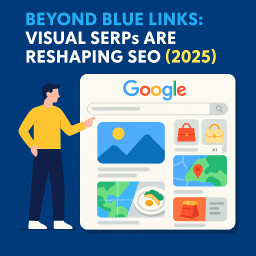
This shift has major implications for SEO. Discover traffic is less predictable, harder to optimise deliberately, and more sensitive to engagement and freshness signals. At the same time, AI-generated summaries and SERP features increasingly satisfy user intent without a click.
EU investigation into site reputation abuse
During this period, the European Union opened a new investigation into Google’s handling of site reputation abuse. The investigation centres on claims that news publishers are demoted in search results when they run sponsored or promotional content, a key revenue source for many editorial businesses.
Google’s enforcement is based on a spam policy first introduced in March 2024 and updated in November 2024. The outcome of this investigation could have long-term consequences for how commercial content is treated within editorial environments.
AI Mode evolves: links, context, and Gemini 3 Flash
On 10 December 2025, Google announced changes to AI Mode in Search, including an increase in the number of inline links, updated link design, and the addition of contextual introductions explaining why a link may be useful.
Later in December, Google confirmed the global rollout of Gemini 3 Flash as the default model powering AI Mode. According to Google, the model is better at understanding nuanced queries, handling constraints, and producing well-structured responses.
For SEO, this reinforces the importance of clear structure, concise explanations, and content that can be easily referenced within AI-generated answers.
OpenAI introduces shopping research in ChatGPT
OpenAI announced the introduction of shopping research within ChatGPT, positioning it as an in-depth shopping assistant capable of performing comprehensive research with a high level of personalisation.
This feature allows users to remain entirely within the ChatGPT platform while researching products, marking another step toward AI systems functioning as closed discovery and decision-making environments rather than simple answer tools.
Google launches UCP and expands agentic commerce
In response to broader AI commerce developments, Google announced UCP, a new open standard designed to support agentic commerce and AI-powered shopping experiences.
UCP will power a new checkout experience within AI Mode for eligible retailers, with plans to expand globally. Google also introduced Direct Offers, a new Google Ads pilot allowing advertisers to present exclusive offers directly within AI Mode.
This confirms that search, AI, and commerce are rapidly converging into a single ecosystem.
Apple reportedly turns to Gemini for Siri overhaul
Reporting during this period suggested that Apple has selected Google’s Gemini models to power the next generation of Siri. The partnership is reportedly not intended to be publicly acknowledged by either company.
If accurate, this development positions Google not only as a search engine and AI product company, but also as a core AI infrastructure provider.
Google takes legal action against SERP scraping
Google filed a lawsuit against SerpApi, alleging unlawful scraping and malicious bot activity that violates website access controls and content rights.
This legal action highlights growing tensions around data ownership, AI training, and automated access to search results, reinforcing that search data is becoming an increasingly contested resource.
Rewriting AI content is not a recovery strategy
John Mueller clarified that simply rewriting AI-generated content by a human does not automatically lead to ranking recovery. Instead, site owners must reassess the purpose of their content, the value it provides, and the overall content strategy.
This aligns with Google’s consistent message: how content is created matters far less than why it exists and how well it serves user needs.
What this period reveals about SEO in 2026
The months between November 2025 and January 2026 made one reality clear: SEO is no longer just about rankings. Visibility is now shaped by AI interfaces, discovery platforms, and transactional systems that may never deliver a traditional click.
Specialisation, clarity, and genuine usefulness are becoming the defining factors of sustainable search visibility.
What the Experts Are Saying
Aleyda Solis: “Core updates continue to reward sites that demonstrate real expertise and a clear focus. Broad, generic approaches are increasingly risky.”
Barry Schwartz: “Many publishers saw sharp declines not because they broke rules, but because the SERP itself now answers more questions without a click.”
John Mueller: “There’s no shortcut to recovery. If the content doesn’t serve a clear purpose for users, changing how it’s written won’t help.”